
Trace Former Todd County Property Owners
Every past-owner chain in Todd County is rebuilt in reverse. Take the newest confirmed deed first. Keep the same legal description. Trace each grantor back to the deed. That deed shows how the person or entity acquired the land. Todd County publishes no cutoff year for its online index, so older links may require Clerk-held deed books and archival finding aids. That is routine for deed records reaching back generations.
| Chain source | Published span | Keeper | Use |
|---|---|---|---|
| eCCLIX deed index | Exact Todd start year not stated | Todd County Clerk | Newest grantee and prior grantor leads |
| Deed books or microfilm | Runs not published online | Ask the Clerk | Earlier transfers beyond the portal |
| Recorded plats | Book span not published | County Clerk | Lot, block, and subdivision continuity |
| Local scans and catalogs | File by file | Todd Library and KHS | Surname, place, and historic-house leads |
Start online for a recent Todd County transfer. When the chain reaches the unpublished digital boundary, take it to the Clerk counter at 202 E Washington Street. The library and the historical society can supply context. But a catalog entry is not proof of ownership. The Todd Clerk online-records page anchors the reverse deed trail.
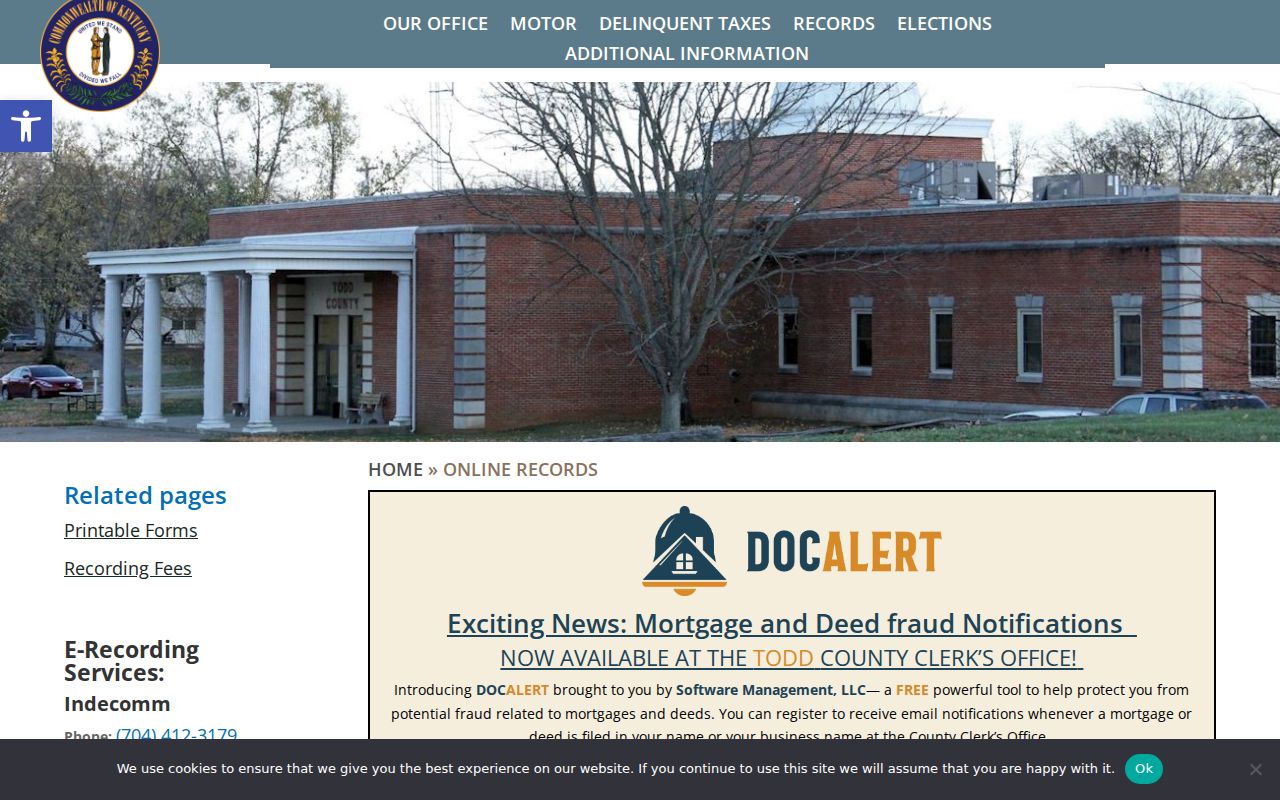
The image shows the Clerk's online-records entry point. It displays no earliest coverage year and no completed ownership chain for any Todd County parcel.
Todd County's eCCLIX Cutoff Is Not Published
The Clerk's eCCLIX page offers free public searching of Todd-only records. Five searches a day are allowed, plus document viewing and printing. What it never states is the earliest index year. It lists no image cutover. It also omits the document range. Nor does it show live grantor and grantee field labels. A missing online hit proves nothing about older deeds. Call 270-265-9966 or visit Monday through Friday, 8 a.m. to 4:30 p.m. Ask for the first and last book numbers. Ask also for the earliest indexed year, the public terminal, and the route through older books. A narrow KORA request can seek a known nonexempt instrument when remote tools fail.
Use Todd County's Surviving Courthouse Story Carefully
An old courthouse raises hopes in Todd County. The county dates to 1820, and the Clerk describes its courthouse as Kentucky's second-oldest still standing. That detail is a preservation clue. It does not prove every deed volume survives. No official fire account, destroyed-decade list, or reconstructed-book inventory exists for the county, so record every book, page, box, or film reference staff supply. Context lives elsewhere too. The Todd County Public Library offers scanned local files, typed phrase searching, and genealogy resources, while the Kentucky Historical Society catalog accepts county, city, surname, and collection terms. Those sources can illuminate a former owner or an old place name, but the recorded instrument remains the authority.
Reconstruct the Todd County Deed Chain Backward
A transfer worksheet keeps similar Todd County names apart. Give every row a date, grantor, grantee, deed type, book and page or instrument number when shown, and the unchanged legal-description clue. The description must not drift from deed to deed.
- Find the newest deed in which the present owner appeared as grantee.
- Copy the grantor and the full legal description from that transfer.
- Search that grantor as an earlier grantee and match the land, not merely the surname.
- Repeat until eCCLIX ends, then continue in the indexed deed books with Clerk help.
- Grantor and grantee
- The conveying and receiving parties.
- Reverse index
- A route from a seller's name to earlier acquisitions.
- Chain of title
- The ordered sequence of transfers affecting the same land.
Explain Gaps Among Todd County Former Owners
Death breaks many a Todd County chain. So do probate, partition, quiet-title litigation, and fiduciary transfers. Search executor, trustee, heir, and estate variants. CourtNet can locate an event, but the Todd Circuit Court Clerk holds the actual file; married-name variants matter here, and any order or affidavit of descent should match the later recorded deed. Kentucky OVS documentation can establish a death or marriage fact, subject to eligibility and confidentiality, though it never transfers title. Title changes only through recorded instruments. The probate authority, the deed, and the parcel description together explain how former owners gave way to the next recorded party.
Carry Todd County's Legal Description Through Time
Street names and mailing labels shift over time in Todd County. A durable property search preserves the subdivision, lot and block, and the metes-and-bounds calls. Keep the adjoining owners. Note any road, creek, or survey reference. Rural land adds another clue. Community names such as Allensville, Clifty, Fairview, and Sharon Grove often outlast a modern ZIP. They serve as historic markers. Trenton's state Land Office filings show how boundary context changes. Examples run from Woodall Subdivision lots to acreage near US 41 and the CSX corridor. Annexation there explains jurisdiction, never ownership by itself.
Search Todd County Former-Owner Name Variants
Older Todd County indexes trust the name as entered. Try middle initials on and off. Add married surnames and given-name initials. Company punctuation and executor, administrator, trustee, heir, or estate labels deserve separate passes too. A surname hit remains a lead until the same lot, acreage, adjoining owner, road, creek, or metes-and-bounds description appears. Follow every citation first. A correction deed, release, affidavit, or plat can clarify the sequence without transferring the whole interest, while Todd's fee schedule confirms these instrument families without establishing online coverage.
Separate Todd County Transfers From Encumbrances
Deeds sit beside other instruments in the Todd County books. Mortgages, assignments, releases, judgment liens, mechanic's liens, lis pendens, and delinquent certificates all crowd the same pages. Each may explain a later sale or lawsuit. None of them automatically creates a former owner. Keep a separate encumbrance column on your worksheet. A tax-bill purchaser buys a lien, not the land, and lis pendens only signals pending litigation. For foreclosure, partition, or quiet title, use CourtNet to locate the event and request the file from Todd Circuit Court Clerk Mark Cowherd, capturing the case number, parties, order date, legal description, and any later recorded deed. The event alone never completes the chain.
Use Todd County Place Names as Historical Keys
Todd County place names make good catalog hooks. Elkton, Guthrie, Trenton, Fairview, Clifty, and Allensville each open a different thread in local property records. Kirkmansville, Sharon Grove, Allegre, and Daysville do the same. Guthrie carries stagecoach and railroad history, so older road and rail references may surface there. Treat every name as a hypothesis first. Then confirm it against a deed, a plat, a county history, or a catalog entry.
The county itself dates to 1820, formed from Christian and Logan counties. Research reaching that far back may need predecessor-county records before Todd County deed books begin. The Clerk holds the exact book, film, and collection identifiers worth requesting. The Kentucky Historical Society holds them too.
Keep a Todd County Former-Owner Research Log
Log every access channel as you work. That includes eCCLIX, the Clerk terminal, phone inquiries, written requests, deed books, and plats. It also covers Todd Library scans and the Kentucky Historical Society catalog. For each result, record the spelling you searched, the date range, and the instrument type. Record whether you saw an image or only an index entry. This discipline matters here. The county page publishes neither a first online year nor an image cutover date. Your log becomes the real map of coverage. A failed web query proves little. A Clerk-confirmed absence is a different finding entirely.
When you request an older instrument, bring the strongest identifiers you have. Grantor, grantee, approximate date, deed type, book and page, and a parcel reference all help. A legal-description phrase helps too. Ask staff where the item lives now. It may sit in an active book, on microfilm, or in another storage location. Preserve each retrieval citation exactly, so another researcher can repeat your steps. If the chain crosses a plat, carry the subdivision and lot labels forward. Probate transfers deserve two entries. Record the fiduciary authority and the later deed separately. A disciplined log keeps uncertain dates and family stories from hardening into unsupported ownership claims.
Mark unresolved links as gaps. Leave them that way until an official book, film, deed, plat, or case file supplies the missing transfer.
How Far Back Todd County Former-Owner Records Reach
No verified online source states Todd County's earliest deed year or image date. Keep working at the Clerk. Library and historical catalogs can locate deed abstracts, plats, microfilm, and county histories from there. Resist two common shortcuts. One is claiming the chain reaches 1820 simply because the county was organized then. The other is calling an online gap a records loss.
Research limit. A reconstructed chain supports house history and due diligence but is not a title opinion. Use former-owner information lawfully and never to harass a living person.