
Todd County Deed Types
The Todd County Clerk records more than simple deeds. Its fee schedule names correction deeds, contracts for land, easements, leases, condominium papers, affidavits of descent, powers of attorney, and restrictions alongside standard conveyances. The instrument label is only a hint. The full terms and the legal description control what the filing actually does.
| Deed Type | What It Does | Common Use |
|---|---|---|
| Deed | Conveys the interest described | Ordinary transfer trail |
| Correction deed | Corrects an earlier recorded paper | Name or description repair |
| Contract for land | Records agreed land terms | Contract-based transaction |
| Trustee or fiduciary deed | Conveys under stated authority | Trust or estate transfer |
| Affidavit of descent | Adds sworn heirship facts | Death-transfer research |
A mortgage, lien, or lis pendens never conveys ownership. It secures a debt or flags a pending claim against the tract. Releases and assignments close the loop by showing whether that recorded burden was later cleared or transferred to someone else. Read the whole chain before concluding anything about title.
Search Todd eCCLIX Deeds
The Todd Clerk online-records page points to eCCLIX. There, a free Todd-only index supports document viewing and printing. The stated allowance is five public searches per day. The vendor's signup notice, however, can show zero public searches. So check the live rule before planning a long session.
The gated form offers no exact grantor, grantee, type, date, book-and-page, or parcel controls. Todd's earliest online year and image cutover are likewise unpublished. Those are access gaps. They are not proof that an older deed is missing from the Clerk's deed records.
| Search clue | Verified status | Use |
|---|---|---|
| Party name | Index confirmed; label gated | Try exact and variant names |
| Document type | Live menu unverified | Use Clerk fee vocabulary |
| Date range | Unverified | Narrow by known transfer year |
| Book/page or instrument | Control unverified | Carry a known citation to the Clerk |
Todd Portal Limits Can Shift
The Clerk's page says five searches. The vendor's central notice can say zero. Note what each page said and keep the URLs, so a temporary account policy never hardens into a false permanent claim. Take a blocked search to the counter, and review the current public signup terms before creating an account.
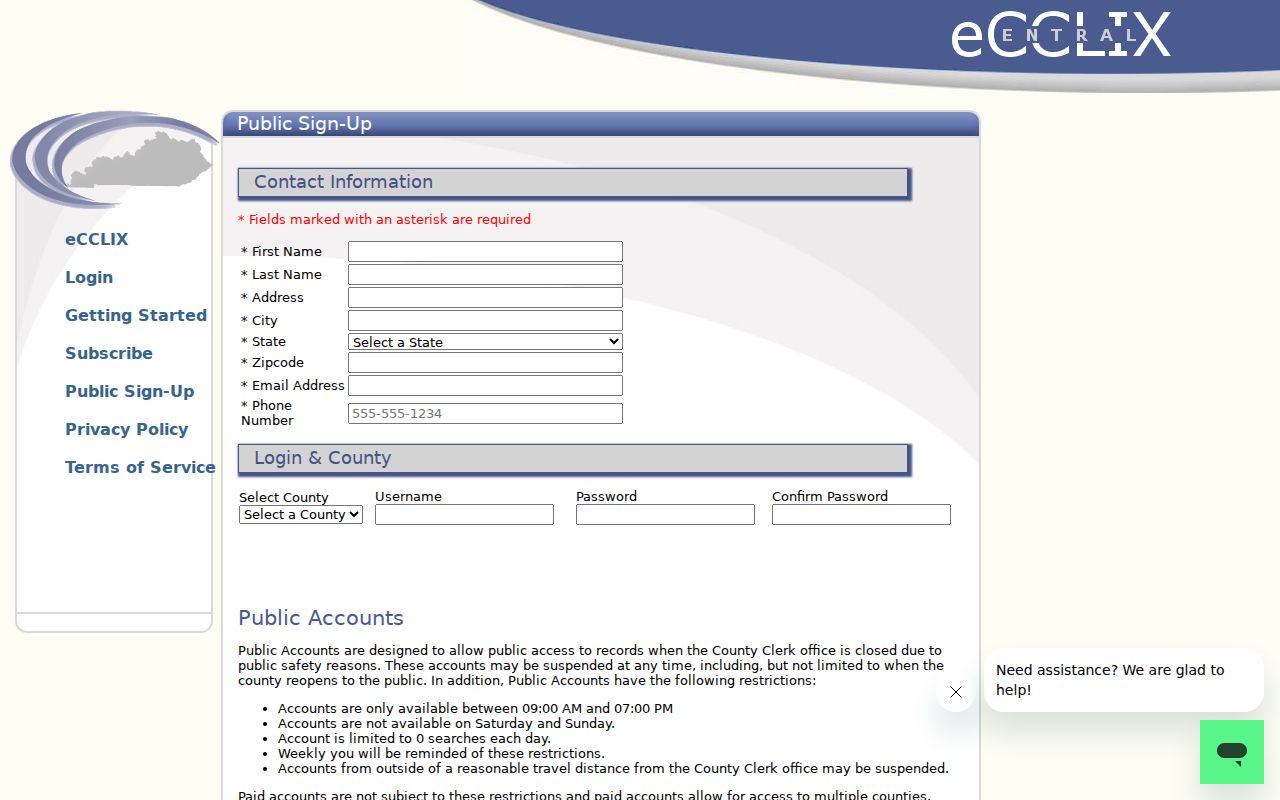
The vendor's signup page carries its own account terms. For Todd County access and certified copies, the Clerk remains the authority.
Follow Todd Grantors and Grantees
A grantor conveys the stated interest and a grantee receives it. Start with the newest known owner and the latest deed. Then follow each prior party backward, matching the same land description at every step, because a shared name alone can point to a different tract.
- Find the present owner's purchase deed with that owner as grantee.
- Copy the grantor, date, reference, and full legal description.
- Search that grantor as an earlier grantee and compare the tract.
- When online records stop, ask the Clerk for the matching deed book and year.
- Grantor
- The party transferring the stated interest.
- Grantee
- The party receiving that interest.
- Chain of title
- The ordered conveyance sequence for one tract.
- Book/page or instrument number
- A locator for a recorded document.
Preserve initials, trustee labels, and LLC punctuation as indexed.
Todd Deed Recording Costs
Todd County's official fee schedule sets out the main recording charges. A standard deed runs $50, a correction deed $46, and a plat $50. Mortgages cost $80, or $126 when an assignment rides along. Easements are $50. Most liens, releases, and assignments sit at $46. But certain state and inheritance-tax liens drop to $5.
Remember that these are filing charges only. They are not certified-copy prices, and they are not a substitute for a title opinion. Check the current amount and the right document category before you file anything.
The Clerk's office keeps weekday hours, from 8 a.m. to 4:30 p.m. Open the Todd fee schedule to confirm the entry for your instrument.
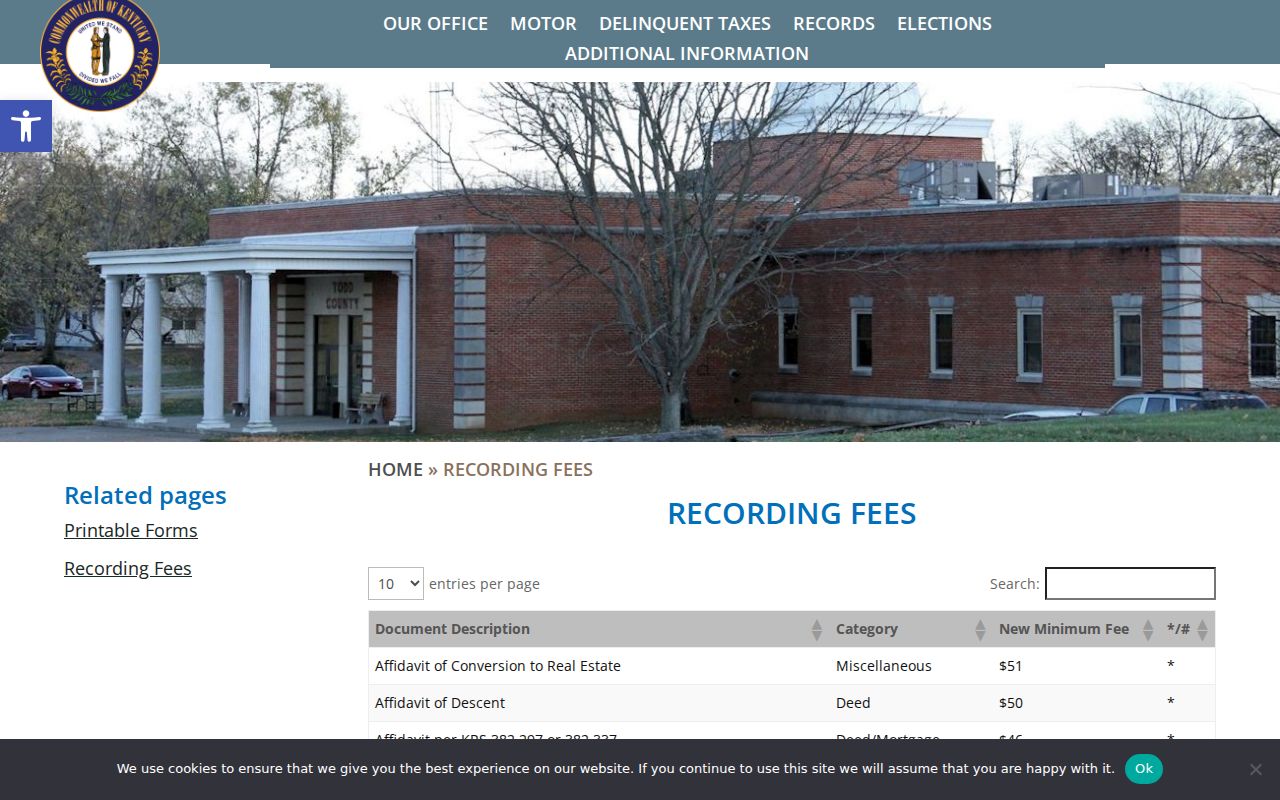
Settle the document type before estimating any charge.
Older Todd Deed Books
Todd County dates to 1820. Its courthouse is Kentucky's second-oldest still standing, so the deed books run deep. The Clerk publishes no online cutoff year. Ask directly about deed-book years, index volumes, plats, microfilm, and any off-site holdings. Never assume the website holds everything.
The Todd County Public Library supports genealogy research. Typed scans there are searchable by phrase, while handwriting takes page-by-page review. The Kentucky Historical Society catalog opens one more discovery path. Neither source replaces an official Clerk copy.
Todd Plats Connect the Tract
City lots carry subdivision, lot, block, and plat references. Rural tracts run on metes and bounds instead. That means courses, distances, monuments, and adjoining tracts. Carry the complete language through every transfer rather than leaning on a street address alone.
In Elkton, subdivision rules send each approved final plat to the Todd County Clerk. The Clerk handles the recording. The zoning ordinance states plainly that zoning never overrides recorded deed or plat limits. City approval and private recorded restrictions answer different questions. So a full parcel search can need both records.
Todd DOC ALERT Watches Filings
The Clerk promotes DOC ALERT, an email notice service. It fires whenever a mortgage or deed is filed in a subscriber's name or business. The published notice leaves out price and full trigger scope, so verify those details at signup.
An alert prompts review. It cannot block a filing or prove fraud. Keep the notice, the recording reference, and the date, then contact the Clerk about any suspicious instrument.
Todd Encumbrances Complete the Chain
A deed chain tells you who conveyed an interest. It does not tell you what burdens came with the land. Todd County's fee list points to the rest. It covers mortgages and their assignments, releases, mechanic's liens, judgment liens, federal and state tax liens, easements, fixture filings, declarations, and lis pendens. When the portal allows, run searches on both the owner and the legal description. Then match every mortgage or lien with its later release, assignment, judgment, or court event. The first filing is not always the one that still controls.
A lis pendens is a recorded warning that a lawsuit may touch the land. CourtNet can point to the event. But the Kentucky Court of Justice says the hearing clerk keeps the actual case file. In Todd County, that means requesting the file from Circuit Court Clerk Mark Cowherd. Bring the party names, case number, date, and case type. Before the pleading or order enters your title timeline, match it to the parcel description. A matching name on a docket is not property evidence.
Estates can push the chain into another branch. Probate authority, an executor or administrator deed, an affidavit of descent, or a death record may explain a gap. That gap often sits between two owners of record. Kentucky vital records carry confidentiality and certified-copy eligibility rules. So the recorded land papers stay the public starting point. The complete chain may therefore run through several stops. These include the Clerk's deed index, the court file, and a properly qualified vital-record request. No single index should be treated as conclusive on its own.
Get a Todd County Deed Copy
Start with eCCLIX when the index and image are both available there. Need a gated image, an older volume, or an official copy? Contact Todd County Clerk Cynthia O'Bryan at 202 E Washington Street, PO Box 307, Elkton, KY 42220-0307, or 270-265-9966. Include the names, an approximate date, the instrument type, and any recording citation you have.
A nonexempt record may not be online. You can still request it under the Kentucky Open Records Act. State guidance calls for a written response within five working days. A delay requires an explanation and the earliest production date. Ask which plain-copy or certified-copy charge applies before you order.
Recorded, not guaranteed. Todd County deed records show filed papers, not a legal opinion that title is clear or every interest has been found.
The wider address workflow sits in the Todd County property search. Deed research should finish with the official image or copy. A name-only index hit is not the ending point.
Write down the exact indexed spelling first. Record every locator the index offers. An entity name may carry punctuation. A fiduciary may show up as trustee, executor, administrator, or estate. Try the displayed form, then a normalized variant. Keep each search in a dated log. That way a blank result can be told apart from a portal limit, an index cutoff, or a true lack of a match.
The deed's situs line and the PVA mailing line do different jobs. One describes the land's common street location. The other routes tax notices. The legal description is the stronger bridge across time. In Todd's rural areas it may cite a road, creek, survey, or tract. It may also name a monument or an adjoining owner. In a subdivision it may cite a lot, block, and plat. Copy that wording exactly, without shortening it.
For any mortgage or lien question, request the related release or assignment. Do this along with the first filing. Todd's fee schedule confirms these are recorded as separate document types. A release recorded years later can change what an older index hit means in practice. A lis pendens likewise should lead to the Circuit Clerk's court file. It should not be read as a final judgment.
A recent deed may also be newer than the PVA owner line. Todd has not published a typical update lag, so do not state one. Save the deed's recording date and compare it with the assessment roll's date. Let the latest official paper set the sequence. That date comparison beats assuming the tax record updates at closing.